Saturday, October 28, 2006

Ecclesiastes 3:1-15 - Life under the Loom

Imagine two little mice who live in a weaver’s shop, a way back 100 years ago. All day long the steady hum of the loom fills their life. Overhead the shuttle passes back and forth colours appear and disappear. Every so often the loom stops and scissors appear and snip a thread and tie it off. A new spool is loaded on and a new set of colours starts. “What did he do that for?” asks one of the mice. “Black is all wrong – why did he stop that beautiful burgundy?” Then off the noise will go again with different colours mingling in among, black, and reds, golds, and purples, greys, and creams, greens, and then it all stops, and snip and more threads are started in – pinks, and oranges, and sunset tints, with yellow and burnt umber. Then stop and snip. And off it goes again.

"That looks a right mess," says one of the mice.

"Well the weaver knows what he is dong."

"What weaver? I don’t believe in a weaver. Sure that machine goes on and on like it always has – right from the day you were born, it just keeps tramping along. No-one outlasts the loom. It will still be going the day you die. And I don’t believe in a weaver."

"Sure there’s a weaver. What about all the changes, what about the rhythm of the loom? What about the design of the carpet?"

"There can’t be a weaver sure the thing is a shambles. Straggly ends of tails everywhere, colours mixing and clashing."

"Ah but it will look great from the other side says the other. There’s a time for gold, and a time for black, a time for red and time for browns, a time to cut and a time to tie. A time to tighten and a time to slacken. That’s the weaver at work – you mightn’t see him, but each thread is planned and designed by him to create a masterpiece. You have to remember that we live under the loom, and we can’t see the whole thing, and even if we could see it, we’re so small that we couldn’t see it all at once."

Living under the loom means two things: we can’t see the weaver, and we can’t see what he is doing – and so to us it looks a mess.

The way the world deals with this is to either pretend that there isn’t a weaver, or that he’s not very good, or that there are some weaving vandals who sneak in and weave dark threads in and although the weaver sees his work marred by these dark threads there’s nothing he can do about it. So either a non-existent weaver, or a stupid one or a powerless one.

What Solomon is arguing here is that there is a weaver, that his plan incorporates all that happens and that he is both good, clever, and all powerful.

God is in control of your life, not you v1-8
The opening verses of ch 1 speak of the repetitive cycle of life, as if the world were some sort of giant machine that just keeps rolling along. Life as we look at it and as Solomon looked at it seems chaotic random and repetitive. Things seem to happen for no particular reason – illness, death, disaster,. But what Solomon is saying in these opening 8 verses is that there is a pattern, and that that pattern is overseen by God.

There is a time for everything. There is nothing that escapes the control of God. There are no flukes or chance happenings in God’s universe.

These verses aren’t our marching orders – these verses aren’t telling us that we need to make time to tidy up and time to throw stuff out, or that we need to make time to laugh and take time to weep. Those things are true, but that is not what Solomon is saying here.

Solomon is not prescribing what we should do, he is describing what happens regardless of what we do. He is not telling us to put order into our lives, he is telling us that there is order in the events that happen to us in our lives. And more than that he is telling us that so much of our lives is beyond our control. We like to think of us as setting the course of our lives, but Solomon outlines here either things that happen to us, or ways that we react to things which happen to us, all of which are beyond our control.

There is a time to live and a time to die. We have no say about when we arrive in this world. Its not as if we were sitting around some table in Heaven with God and we said, “Well now’s the time I would like to make an appearance”. And neither, in the natural course of things, do we choose the time or manner of our deaths.

These are events over which we have no control. And Solomon is saying much more than the set events of birth and death are decreed, but everything in between. It is all appointed by God.

There is a time to plant – sowing in winter is pointless, God has set the season for planting and the season for harvesting.

And even when man does what he should not – the destructive events of life like murder – these are not outside of God’s decree. God isn’t sitting wringing his hands wondering what’s going on. And although man is utterly sinful and chooses to sin, God is still sovereign. Nothing catches him unawares.

There is a time when healing comes, and we get better from whatever was afflicting us – who chooses that time? Some of you would love to be able to choose that time, but that timing is in God’s hands. Neither do we choose the times of joy in our lives, and we can’t choose the times of sorrow – they come, often when we are least ready. They catch us unawares.

There’s a time of victory – scattering stones on fields was was victorious troops did to render the land unproductive; and there’s a time of defeat – when you are on the receiving end. Again it’s not up to us.

There’s a time when close family love is able to be expressed, but there are times and circumstances that mean we aren’t able to embrace. Distance, work, sickness.

Things get lost and we have to look, things wear out and we have to ditch them. Often the timing of that isn’t in our hands. We don’t plan to lose something and spend half and hour turning the house upside down looking for it. We don’t plan that today I will wear out my washing machine. It happens. So much of our lives are outside of our control.

And so it goes on –

a time to keep and a time to throw away,
a time to tear and a time to mend,

Grief, along with the tearing of garments comes unbidden, and unannounced. But there is also a time when grief’s pain has subsided and we can mend the garments and start to get life back in order. But these times aren’t something that you plan or orchestrate yourself.

a time to be silent and a time to speak,
a time to love and a time to hate,

Times when we are in circumstances where we are filled with love, times we are brought into circumstances where we see things we wished we hadn’t.

a time for war and a time for peace.

All of life is encompassed, all our emotions are included, the whole sweep of human existence, the good and the bad, the creative and the destructive and what Solomon is saying is this – you don’t control your life half as much as you think you do. And he is not being fatalistic, he’s not talking about the tyranny of time, as if he wants us to throw up our hands and say – well it doesn’t matter what I do.

The whole point of this is to put us in our place.

Unlike William Ernest Henley who wrote a famous poem called Invictus which ends like this:

It matters not how strait the gate,
How charged with punishments the scroll,
I am the master of my fate:
I am the captain of my soul.

Solomon says, “Oh no, by no means are you the master of your fate or the captain of your soul. You can’t even control what happens to you and around you.”

And how often we are apt to make that same mistake we think, “ I’ll go here and do this, I’ll save for Christ years, and then buy such and such. I’ll retire at 50 and take the rest of life easy.” Or the most famous one, “I’ll become a Christian when I’m older.” As if we are somehow in control of the twists and turns of our lives. As if we know that there will be a later, or a 50, or 7 years time.

These verses are humbling
We are not the mighty intrepid explorers of life that we think we are, instead we have to take what cards we are dealt.

In one sense he does want us to despair. He wants us to despair of thinking that we rule – because that is the whole point of sin, we think we rule our lives, that we can shake our tiny fist at God and say, “How dare you tell me how to live”. Solomon wants us to see the futility of thinking we’re in charge of our own lives.

And as James says,
13Now listen, you who say, "Today or tomorrow we will go to this or that city, spend a year there, carry on business and make money." 14Why, you do not even know what will happen tomorrow. What is your life? You are a mist that appears for a little while and then vanishes. 15Instead, you ought to say, "If it is the Lord's will, we will live and do this or that." 16As it is, you boast and brag. All such boasting is evil. (James 4)

These verses are also realistic
Look at the list and see what Solomon is saying –
Life for us in unpredictable. Life will have its share of pain. Some Christians live as if God has forgotten what he is doing whenever trouble comes – they think that if you trust Jesus all will be rosy for you. Not Solomon. For Solomon, disaster doesn’t mean that God is absent. Too often I hear pastors and Christians after some tragedy or disaster saying something like, “God didn’t want this to happen, God didn’t plan this, God had nothing to do with this.” And while that seems like nice advice at the time and seems to let God off the hook, it simply reduces God to some weak ineffective nice old man who wanted nice stuff to happen but is powerless to make it happen.

Solomon’s God is much more robust than that. Solomon’s God is sovereign over the disasters as well as over the good times. We come to the obvious question in a minute.

These verses also give great confidence to the one who trusts God.
Everything is planned – there are no flukes, no accidents. The Bible tells us that he knows the number of hairs on your head, that he is aware of all the movements of even the smallest birds – and it is not just a case of knowing what is happening, it is a case of directing it. So when God says, “I know the plans I have for you” (Jer 29:11) he means exactly what he says. Everything that comes to you, from the cradle to the grave, comes from the hand of a God who only ever does what is right. Here is a warrant for confidence

This is breathes life into us when the hard times come, this gives us stability when the storms of life batter down on us – everything under the sun is controlled by a sovereign and personal God.

That raises an obvious question – if the universe isn’t a soulless series of events but rather is a series of events orchestrated by a personal God – is that not worse? Consider if a branch falls from a tree and kills your child that is completely different from someone cutting the branch off a tree to land it on your child.

Two aspects to the answer – this world isn’t all that there is, and this world isn’t the way God designed it to be. That doesn’t mean that he is helpless to change it – it just means that the change required is much deeper reaching that we ever imagined. Our world is full of natural disaster and sickness because we are here – God condemned the whole physical universe because of our sin. So if all sickness and suffering and disaster are to be banished, then man will have to be radically dealt with too. We either need to be wiped out, or transformed.

And that is what the Gospel promises. Everyone who comes to Jesus will be transformed, everyone who doesn’t will be punished. And tehn there will be a new earth populated with people who no longer have the ability to sin, and the earth will no longer rebel at our presence or be under God’s curse.

This is what we long for and this is in part what Solomon means when he says, “God has set eternity in our hearts.”

There is a big picture, but you can’t see it v9-11
Solomon expects us to ask this question that’s why he says, “What does the worker gain from his toil?” – this is his way of asking what is the purpose and meaning in life? “I have seen the burden God has laid on the hearts of men” – he means this whole business of the ups and the downs, the good and the bad, the fluctuations of life.

And then he answers his own question and he tells us 3 things

There is a big picture and each piece fits

“He has made everything beautiful in its time. Solomon is not saying that everything is beautiful in itself, but in its time. Bad things happen to Christian and non-Christian alike. But what Solomon is saying here is that there is a big picture, and each event has its place in that picture. And what God is doing is creating something beautiful. We get glimpses of that even in our own lives, where something has happened to us, it has been hard at the time, but God has used it for good. And when we get to see the pbig picture we will see that everything has its place.

Here is where part of our confidence comes from – it isn’t all haphazard, each event has a purpose and place.

We know instinctively that there is a big picture
Solomon tells us then that we know instinctively that there is a big picture. “He [God] has set eternity in the hearts of men”. Although it’s kind of hard to prove, monkeys, and cats and cows aren’t sitting wondering why things happen to them, or why they are here, or what their purpose is in life. This belongs to mankind. God has wired us in such a way that we know instinctively that there is more to life than this. Someone dies, and we know they have gone, but somehow we feel that they still exist. There is something in us that knows that there is more to life than this. When we see a great evil done, and the perpetrator takes his own life, we instinctively feel that that isn’t fair, that there has to be some form of justice. That’s not just a fond yearning, God has set eternity in our hearts.

Whenever things happen to us we instinctively want to know why – that is part of eternity being set in our hearts – because God is a rational God, and he has made us in his image and because of that we know that there has to be a reason for everything, things don’t just happen at random. So the very act of wanting to know why is a God given instinct.

We feel that in eternity we will see everything evened out. There we will see the big picture.

We can’t see it in this life
Solomon tells us that “no one can fathom what God has done from beginning to end”. What he is saying is that although there is a reason for everything, and although we instinctively know that – we don’t actually know the reason.

We don’t get all the answers. And that’s frustrating. In other words, God gives us a desperate thirst for answers to why – but he only ever gives us glimpses of the answers. Now why would he do that? Because he wants us to set off on a search, not just for the answers, but for the answerer. Our big problem isn’t that the world is puzzling, and that we need solutions, our big problem is that we are messed up and we need help.

God’s big aim is that we get to know him. If you don’t have the answer to something, you set out to look for someone who does. And all the questions that we ask find their answer in God.

But more than that God does it because he wants us to trust him. You see even when you become a Christian you don’t get some sort of answer book, its not as if you have become the teachers pet and get the inside track on everything. Solomon says here, “they cannot fathom” that means no-one.

And that’s comforting in a strange way for many times things happen to the Christian adnd we wonder why – why a miscarriage, why an illness, why did I have to spill water on my keyboard when I was writing this sermon and fry my keyboard. How does that fit in to God’s vast eternal plan? And we never get an answer. And the reason is this, God doesn’t just want to satisfy our curiousity, he wants to satisfy our deepest longings. He isn’t going to be treated as some sort of cosmic answer man, but he wants us to trust him and relate to him.

There are times when as a father you have to do things that you can’t explain to your kids, they just don’t have the mental ability to take it all in – the factors are too complex, so you say to them just trust me. That’s what God is doing.

How then should we live? v12-15
3 responses then

Humble yourself and trust God
If the whole point of the ups and downs of life is to bring us to the point where we see that we aren’t as wonderful as we thought we were; and if God has given us this instinctive reaction that we know there is more to life than this, then the thing to do is to humble ourselves and go to this God and say, I can’t cope, I need you.

That’s what v14 is saying, “God does it so that men will revere him.” The whole purpose of it is to bring men and women into a right relationship with God.

And why would that God accept a person who for years has said “I want nothing to do with you?” Ecclesiastes doesn’t tell us, for that we have to go to the New Testament, and we find that Jesus is the one who reconciles men to God. Because Jesus came to bring people back to God, and he did it by taking the blame for all their years of self-rule and putting other things in the place of God.

And this is important because as v15 says God will call the past to account. There will be a day of judgment when all people will see that God is in charge, and that he will punish all who failed to recognise his authority.

And the fact that we are not in control of our own lives as much as we think we are will be that we are totally unable to escape what God has in store for us, unless we have asked Jesus to take the punishment for us.

Live by trusting God
For the Christian the issue of trust isn’t just about starting the Christian life, it is how we live it. Whatever comes to us, we need to realise that our times are in his hands (Psa 31:15)

The Christian is like a mouse who gets to run on the half finished rug on the loom. We can see why some of the colours are there, sometimes we know why some of the blacks are there, but we can’t see the full design yet. And its only in Heaven we will get to see the full design and to understand fully why there are all the colours and shades that make up our lives.

Yet while we are here we need to remember that there is a weaver, and because of Jesus he cares passionately about us.

And where the illustrations break down there is another great truth – for becoming a Christian is like having a personal relationship with the weaver. You still can’t see the whole picture, but you know the weaver and you know that as he weaves the threads into your life, it is out of love and nothing else. And because you know him and you know he loves you, you can trust him with you life, and whatever colours he introduces you take as being from the hand of God.

And in all circumstances the weaver has said I will always weaver what you need into your life – whether it is strength, comfort, courage, my presence. He promises that the ups and downs of the times of our lives will never be so much to swamp us.

There are things we will never fully understand in this life – but we are never to give up on God’s sovereignty.

And because of that it is possible to

Enjoy life as it comes

v12 and 13 Solomon writes “I know that there is nothing better for men than to be happy and do good while they live. That everyone may eat and drink and find satisfaction in all his toil, this is the gift of God.”

Once we accept that God is sovereign and we are limited, and put our trust in him through Jesus, then we can know that there is a big picture which will turn out for our best, that we have a personal relationship with the weaver of our lives, and that this plans are not to harm us but to prosper us and to give us a hope and a future.

And this is a gift from God – not something we can earn. And if we let this truth sink down into our lives we will be able to live lives marked by contentment, enjoyment and confidence amid all the tensions of the times that come to us. And this doesn’t mean walking about with inane grins on our faces, but this joy is deep and profound, one that sees the trials instead of ignoring them, but looks to the hand of a gracious father behind them all.

You see, some Christians don’t think this life is to be enjoyed - they look on this life as something to get through – fix your eyes on Heaven, thole life – and you can tell them by the look on their face. Grim determination. Rarely do you see them smile and relish the simple pleasures. Solomon hear only echoes Paul “Whatever you do, whether you eat or drink, do it all to the glory of God”. There is a joyless Christianity that betrays our Saviour.

But delight in God is our duty – and it is a possibility, “delight yourself in the Lord” Ps 34:7 says, Neh 8:10 says the joy of the Lord is your strength.”

And this is what Ecclesiastes is about, delighting in living for God and under God in a fallen world, delighting because we have a saviour who died for us, a father who loves us and a Holy Spirit who transforms us, delighting because your God is sovereign, and nothing can happen to you except what he permits for good reason. Here is the freedom to enjoy life as God gives it – not always harking back to the past, or looking forward to the future for better times, but enjoying whatever time God has put you in now.

That is a gift of God to those who live under the loom of life but trust the weaver who has laid down his life for them.

Friday, October 06, 2006

Ecclesiastes 1:1-2:25 - Nowhere to run to

At the 2003 MTV awards show, Johnny Cash’s video “Hurt” was nominated for an award. Cash didn’t win. But the showing of the video caused an almost palpable discomfort in the crowd. The video to the song features haunting images of his youthful glory days—complete with pictures of his friends and colleagues at the height of their fame, now dead.

As the camera pans Cash’s wizened, wrinkled face, he sings about the awful reality of death and the vanity of fame: “What have I become? My sweetest friend/ Everyone I know goes away in the end/ You could have it all/ My empire of dirt.”

“It’s all fleeting,” he told MTV News. “As fame is fleeting, so are all the trappings of fame fleeting; the money, the clothes, the furniture.”

The face of Johnny Cash reminded this generation that he has tasted everything the MTV culture has to offer—and found there a way that leads to death. His creviced face and blurring eyes remind them that there is not enough plastic surgery in all of Hollywood to revive a corpse.

Cash found an alternative to the vanity of shifting celebrity. He found freedom from guilt and the authenticity of the truth in a crucified and resurrected Christ.

(from this article)

Johnny Cash was a modern day Solomon – both had lived the life of celebrity, enjoyed all that this life has to offer and seen through it. And both sat down to write their experiences as a warning for the rest of us.

Are Cash and Solomon cynics and pessimists? No, although this book seems really pessimistic, Solomon is doing us all a favour. He is recording the results of his fouled up life which he lived like an experiment to answer the question – What is life for? What makes my life worthwhile?

He isn’t sitting pondering this in his mind, he writes like Johnny Cash – from a well of experience that he doesn’t want others to plumb. And he tells us four things from the depths of that well

Without God your life is a footprint in sand 1:3-11
v1&2 Solomon introduces himself and his theme. In v3 then he asks a key question

“What does a man gain from all his labour at which he toils under the sun?”

Or “What profit does a man get after all his labour?”

The word profit here is an accounting word, used of an accountant sitting totting up the columns in his book, and he comes to the bottom of the list, and all the costs, and payments have been made – what is left? What has been gained that is of real and lasting profit?

That’s the question Solomon is asking.

He has already given us his answer in v2 – profitless, everything we could do is without lasting profit. And now he seeks to show us that whatever we devote ourselves to is as lasting as a footprint in the sand, washed away by the next wave or blown away by the next breeze.

In v4 he reminds us of the tragedy of death. Life is not profitable because, despite all the toil in life, one day you will have changed nothing on the earth and then you will die. And man who is made of the earth disappears while the earth of which he is made remains constant – almost as a mockery.

Solomon tells us three things about our great lives that we think accomplish so much:

Man himself is fleeting – a footprint in sand
v4 Generations come and generations go, but the earth remains forever.

One generation enters the earth as another is dying off. Each generation thinking that they will make progress, but the only progress they make is to the grave. And as wave after wave of men, women and children return to the earth, the earth itself remains constant. The earth tramps on regardless – not even pausing to note the passing of great men or women.
Man’s work is fleeting
The earth itself illustrates this futile round of things – the sun rises and sets, and there it is in the mrning again. The rivers do the same, always running, never emptying, you cut the grass and it needs cut next week, you wash the dishes and you turn your back and the sink is full again, you get your hair cut only to need it done again in a few weeks time, you weed the garden only to find the weeds back.

One generation after the other enters the earth frantically moving with all the vigour of a guy on an exercise bicycle peddling like mad and going nowhere. And then we die, and our gardens which we so carefully planted return to the wild, our house which we so carefully kept clean fills with dust – someone else moves in and it is as if we were never there. Even the great civilisations of the Babylonians, the Incas and the Greeks are reclaimed by nature and little remains of the mighty empires.

Man’s innovations are fleeting
Ah but what about people who really make their mark? Who like? Like the guy who invented the Tilly lamp, or the fiddle for sowing corn, or the ram for pumping water from a river to houses uphill. Or what about the guy who invented the Betamax video recorder? Or what about the walkman, the record player, the valve radio, or the indicators that used to pop out on the side of cars.

And the people who invented all these are no more remembered than a footprint in the sand.

There is nothing new under the sun –

v10 Is there anything of which one can say, "Look! This is something new"? It was here already, long ago; it was here before our time.

But what about nuclear power, or computers, or robotic milking parlours? What are they really but ways to do the same things as before except in bigger and faster ways. The only thing that changes is the scale – more power, faster calculations, bigger herds.

Even the best achievements of man are fleeting.

Man’s remembrance is fleeting
v11 There is no remembrance of men of old, and even those who are yet to come will not be remembered by those who follow.

As a kid my favourite tv programme was record breakers. I loved seeing the attempts to see who could lift the most, eat the most, balance the number of crates on your chin etc. I loved browsing through the Guiness book of World Records. But there is something ultimately depressing about GBWR – old editions sitting in second hand shops. Worthless because they commemorate worthless achievements because the achievements have been surpassed. All that effort and training, all for no avail, the next year someone beats your record. And no one remembers your name.

This is bleak, but ultimately it is right – we are so used to placing ourselves at the centre of the world and thinking that the world rotates around us – but here is a sobering reminder the earth itself pays no attention, and neither ultimately do our fellow man.

Walk along the beach, near the waters edge and watch your footprints dissolve – that’s what you are, a fleeting imprint that is there for a little while and is gone.

Ah, you say, maybe I shouldn’t look to leave a mark then, I should just look to get as much as I can here and now. Solomon tried that, and he found that there is no sufficient replacement for God

There is no sufficient replacement for God 1:12-2:10
In these verses Solomon enters in to a great experiment. He asks himself another question in v3

“I wanted to see what was worthwhile for men to do under heaven during the few days of their lives.”

And so like many people before and since Solomon set out just to enjoy life for all it was worth. And these verses instead of being 3000 years old could be a description of Letterkenny main street on a Saturday. Solomon surrounded himself with comedians v1, he tried alcohol, not getting totally plastered, but enough to have a good time free from inhibition v3, he then went for live bands and music of all descriptions v8, and then sex as much as he wanted as often as he wanted v8 – he had 700 wives and 300 mistresses. v10 There wasn’t anything pleasurable that he skipped out.

And it wasn’t just pleasure that he went for, like so many people before and since he poured himself into his work, amassing property, building great schemes, both business and farming, gathering money, so much that it says in 1 Kings 10 that silver was as common as stone.

Whatever there was to do this guy did it – whether pleasure or work.

You see our problem is that there are very few people in the world who have the time or the money to pursue pleasure or work as far as they want. And so the myth persists that if only I was a little richer, or a little more successful, or a little more attractive, or had some more land, or some more brains, then I would be happy.

So mankind persists in chasing a lost cause. And we don’t stop to listen to the voices of those who have been there, Solomon, Johnny Cash, or even Robbie Williams – who once he got to the height of his fame found that fame and money still left him feeling empty inside.

It is the despair that Solomon voices 2:11

Yet when I surveyed all that my hands had done
and what I had toiled to achieve,
everything was meaningless, a chasing after the wind;
nothing was gained under the sun.

v 17
So I hated life, because the work that is done under the sun was grievous to me. All of it is meaningless, a chasing after the wind.

As Scottish band Del Amitri said, “The disappointment of success hangs from your shoulders like a hand-me-down dress.”

What Solomon wants us to see is that none of these things, nor anything else is a sufficient replacement for God.

You see this is what sin is – so often we think of sin as being doing wrong things, but at its heart lies this – putting something else in the number one place in our hearts. Sin is basing your life on anything but God. That’s what the first commandment is – you shall have no other gods before me. Sin is taking even a good thing and making it into the ultimate, building your identity around a thing rather than God. So if you make as the main source of your happiness in life your self-esteem, your farm, your success, your looks, your goals, the approval of others, your children, anything – if you say If I had that, or did that, or achieved that I’d be happy – what is it that you want more than anything else – if that isn’t God then you are doing what Solomon did. Except he got what he aimed for because he had enough money and enough time on his hands – and still he said it doesn’t satisfy.

These things, the search for self esteem, riches, approval, success, whatever will drive you into the ground, if you get what you want it will disappoint you, if you fail to get what you desire it will crush you.

These things are not a sufficient replacement for God, because Jesus is the only master who satisfies, and when you fail him, he is the only one that will die for you to make you right again. And you can see that yourselves – ask the question what use are any of these things when the great trials of life arise?

Young people here is a guy who has had it all, standing before you today pleading with you to set your heart o God, because all else fails.

The thing to realise is that your heart is an idol factory – even for the Christian – constantly inventing things for you to put in the place of God. And Solomon says to you – all of them will disappoint you in the end.

So our significance and meaning are not to be found in making a mark on the world, or in living life to the max. As Solomon says in v23 – All this is meaningless – unprofitable, empty. Solomon isn’t being cycnical or pessimistic he is being utterly realistic because he wants us to see that:

Without God, despair is the only honest alternative 2:11-2:23
It is a very clever book – Solomon is setting out to drive people to despair. Not out of cynicism, but out of love. He has lived this life, now in his old age, broken by his sin, having seen the effects it has had on his kingdom, he writes with a repentant heart to warn people of the dangers of following the idol factory of our hearts. He knows that most people don’t get to see the emptiness of life until it is too late, they aren’t rich enough or successful enough to see that the path they are on falls of the edge of a cliff. But Solomon has been to the brink and comes back to tell us.

But he isn’t the only one to see it. An atheistic philosopher once said, “Suicide is the only sensible option, but few have the courage to take it.” And he is right if all there is to life is be born live, die. If there is nothing to live for, and if disease, disappointment, depression, and doubt along with break up of relationships, family and natural disasters can strike anyone in random fashion then he argued what’s the point of going on?

That is precisely the force of this opening section of Ecclesiastes. Without God despair is the only honest alternative. There is a dishonest alternative – to bury your head in the sand and shout, “I don’t believe you.”

And as I have said before those who are on the brink of suicide and depression sometimes see life most clearly. We all think that they are deluded when they ask “What’s the point? What’s the point in getting a job and then working for a lifetime when you’re only going to die? How do you know that someone will love me and be there for me, how do you know that things will get better? This world just rolls on and misses no one, so I’ll not be missed.”. But at a deep level they see things more clearly, they have stood on the brink and seen what Solomon has seen. And the vast majority of life just gets on with life, getting hopelessly lost in the boring repetitiveness of life with all its trivialities – pretending that the big questions don’t exist.

Well they do exist, and Solomon wants us to look at them, so he launches his attack to destroy the false optimism that people cling to.

And what Solomon is saying is that this despair is vital. If you haven’t come to that point of despair – either about your own state before God, or about life in general, where you know that you don’t have the answers and that you can’t help yourself, and that you know that nothing in this life can either – then you aren’t going to see life as it really is. Jesus job is to show you the meaninglessness of life apart from him. Like Paul in Phil 4:8 – I consider all things dung without Christ – because all things are dung without Christ.

And so if you are not a Christian and things are going wrong in your life – God is teaching you. He is forcing you to look at life and see what your priorities are, to see what has claimed the place that belongs to him. What is most important to you? See that unless you have a relationship with God you will fill your life with all sorts of stuff to fill the emptiness, and then you will grow to hate the stuff because it ultimately lets you down.

But where the atheist philosopher had no answer, and where our hearts cry out and override our minds and say, “But there has to be more to it than this” Solomon doesn’t stop – he points us to an answer.

With God there is meaning purpose and joy 2:24-26
That’s where he brings us to in v24-26.

He doesn’t stop with meaninglessness. He tells us that enjoyment itself and making sense of this world, and finding a way to understand life, to have happiness amid the monotony of life, and the hurt of life is a gracious gift of God.

v24 reads more literally “There is nothing good in a man that he should eat and drink and find satisfaction in his work.”

In and of ourselves there is nothing, absolutely nothing that we deserve. It’s all a free gift from God. And so even when those who aren’t Christians enjoy things in life – this too is a message from God. He is seeking by his kindness to draw you to him. CS Lewis said “God whispers to us in our pleasures, speaks to us in our consciences, but shouts to us in our pains; it is his megaphone to rouse a deaf world.” God has given you that in grace.

What Solomon is saying is that when we make wisdom, knowledge or happiness our chief aim, we get meaninglessness, but when we make God our goal it is then that we get wisdom, knowledge and joy given to us, because this pleases God.

This is quite simply the gospel – give God his proper place, and he will freely reward you – not because you earned it, but as a gift of his grace. Free, the ability to enjoy life with God at the centre is a gift that God gives. You can’t earn it.

Push God off the throne, and you may get short term pleasure in this life, but you will find that it has been of no profit to your soul. Restore God to his rightful place, and you will find that no matter what life throws at you, you will see a meaning and a purpose – and that will give you a deep contentment even amidst the trials.

Christian friends, pushing God off his throne isn’t just something non-Christians do. We know Jesus is king, but we still find ourselves putting other things in the place where he should be. And when we do we find ourselves getting discouraged and down – and that’s because things or people can’t sustain hat weight of expectation, they will let us down. And so even when our heads ell us that we know Jesus is first we find ourselves discouraged because we have low self esteem, or because we don’t feel as appreciated as we want, or because we are saying “If only I had this, or if only I was like this, then it would be so much different”. And we have made exactly the same mistake. We have tried to find our meaning, value self worth, in acceptance, success, possessions, love of something, or someone other than Jesus.

And in the low points Jesus is our teacher, even more than Solomon is and he comes and says, You’ve pushed me off my throne, you need to find yourself in a deep love relationship with me, and then you will have meaning and joy and esteem, and love, and in me you will have success, and position far more than this world can measure.

Saturday, September 16, 2006

Letters: More on Relationships

XXXX

Good to hear from you again. Hope your studies are going well. I see doubts are still playing on your mind. You mentioned the other girl who you have more in common with:
This worried me as I was scared I would fancy her. I don’t think I do, but its always a fear of mine that could happen.
That is something you can have control of - the devil will always find someone to tempt you with in a relationship, no matter who you marry. So you need to learn to fix your mind and your eyes on one person. The grass always looks greener elsewhere. It wont happen if you don't let it.
also xxxx seems to really really really really love me, and that scares me.
It's understandable that you're scared if you aren't sure about your feelings for her - you don't want to hurt her that much.
I love spending time with her, and love being with her, but when were apart I only rarely miss her
I'm exactly the same. I can go away for a conference and not miss Judith at all, until I phone her, or hear her voice. I think some of us are wired to focus on what we are doing at one moment, and we are so focused on it that other things don't get taken into account. I wouldn't worry too much about that issue. The fact that you love spending time with her is the key aspect.
these are her good points
1 loving
2 Looks out for the best for me
3 patient
4 Puts me first over her - a lot
These qualities above are ones that make her a good partner.
5 Great Christian striving to grow more with God
6 Encourages me to grow
These are the mark of a good Christian partner
7 attractive
8 her family are great
These are nice bonuses!

All-in-all that's more than most relationships have!
not so good points…
No-one is perfect, the issue is can you live with these imperfections? If this is all that's wrong, I would suggest you are on a winner!
find her humour irritating(not so a bad point, but I can’t seem to let it not annoy me at times)
Partners do annoy each other at times, the key is to deal with it Christianly. I can tell you that no matter who you marry you will always find something annoying about them. And the devil will magnify it and make it seem like the most annoying thing in the world. Its all about how you react. Pray about it. (not that she'll become funny, but that you'll be able to live graciously with the things that annoy you.)
don't share alot in common
Not so important as long as you have things you can talk about. If you have everything in common there isnt as much to talk about. Now you have twice as many areas. Learn to be interested in what interests her. Make every effort to understand her life and remember to ask about the things she's doing. Be genuinely interested and remember what she says and ask more the next time.
sometimes doesnt listen well, but she is striving to improve.
You can help her by talking about the problem openly.
she seems to see my bad points and move past them and want to marry me.
That's a mark of maturity. Again another good sign. It might be the case that you need to focus on maturing more as a Christian - ie growing as a man of God. In other words focus on growing closer to God and that will bring you closer to xxxx.

Focus on the Godward relationship and the relationship with xxxx will be helped.

To sum it all up:

- You wont find the perfect partner. And she seems first class.
- Ask yourself, "Is she someone I could come home to every night?"
- Don’t ask yourself, "Is she the right one for me?" but "Am I being the right one for her?" in other words, Do I put her 1st over me, and look out for what's best for her? (What areas are you praying that xxxx will grow in as a Christian? - that will be a good indicator of how to look out for her heart.)
- Dont make any decision yet. Wait a year and concentrate on your relationship with God.

You need to tell her:
- that you are waiting a year with no pressure to decide.
- that she's not on trial, she's nearly perfect!
- that you love her, but you want to make sure that you are right for her.
- that you're giving yourself time to grow as a Christian, not leaving time for her to prove she is perfect after all

Then:
- do all you can to grow as a Christian
- do all you can to show xxxx she's important to you
- talk about things openly - dont leave her guessing
- praise her good points, and dont draw attention to her bad points. (this will help you to keep from focusing on the things that annoy you.)

Hope this helps. From your brother in Christ.

Sorry its so long an email, but relationships are never simple!

Mark

Wednesday, September 13, 2006

Quote of the day

Walter Kaiser makes this comment regarding the death penalty:
"Such action is favoured in scripture, not because men are sovereign or because society and the bereaved are somehow benefited, but because man is so vastly important to God - he is made in the image of God. To kill another person is to kill God in effigy."
And we all know the fuss that is made whenever a effigy of some world leader is burnt.

Saturday, September 09, 2006

Letters: More on Relationships - We don't have that much in common

XXXX,

Good to hear from you. I'll just go down through your email and make a few comments and then try to tie it all together at the end. Hopefully that will help.
The problem is that I don’t know exactly what I have doubts about. Sometimes I find that she really irritates me! And then that really troubles me - if we are like this now, what might it be like later.
It's 'ok' to find each other irritating 'sometimes', as long as its not too regularly! A relationship is between two sinful people, and a relationship between two Christians is one that the devil will especially seek to get each to rub each other up the wrong way. No relationship is perfect this side of Heaven. That doesn't give you licence to be irritating though!

There are things about me that irritate Judith, and vice versa. I am completely untidy and she is completely organised. She tidies up, and then I cant find the things that I had left lying about.

But the amazing thing is that God's grace has been like an oil that reduces the friction, as he makes us more Christlike.
also I don't have much in common in xxxx.
I have very little in common with Judith. I'm a rock climbing, rugby loving, football watching, fan of every sport imaginable who loves to read, and design stuff on the computer, and discuss theology. Judith doesn't have much time for sport at all, doesn't read books much, and doesn't discuss theology the same way other friends do. I enjoy it when a day takes unexpected turns, she likes to know exactly what's going to happen next.

If you tried to match Judith and I up using conventional dating methods we would never be put together. But God put us together. Thank you, God.

I think we can put too much emphasis on what the world puts its emphasis on. They know that there is something in being like-minded, but they don't realise that being like minded in Christ is the most important one. And if that is right, many other things will be covered by growing in grace.
After we started going out I met another girl with whom I have alot more in common. This worried me as I was scared I would fancy her.
There are plenty of other girls that I know and care a lot about that I have more in common with. Girls who are sporty, girls who love books, girls who discuss theology - but do I want to spend my life with them? No.

Also I have discovered more things about Judith since I married her that have made me see that God has us perfectly matched - but the point to note here is that it was after we married that I discovered them! God's plan for marriage isn't for two identical people to get together - Eve was made as an emotional, intellectual, physical, spiritual counterpart to Adam to complement him, not to match him.

(Of course having a few things in common helps a bit!)

All the best for now

Mark

Thursday, August 31, 2006

Letters: On Relationships - Is she the one?

hello there.

how goes it? I have to say congratulations on having another baby! So hows that all going? Sounds cool!

Got plenty of assignments to do, which is loadsa fun. Things with xxxx have been going well. But I still have doubts. Sometimes I think I will get married to her, and then there are times where I’m like I dunno about anything, and I’m just a bit confused and have doubts. The thing is she really loves me, and she knows that I have doubts at times.

I wish that I could be sure of us. I’m worried that in a years time or longer I’ll realise that we shouldn’t go out, and I’ll look back and realise I shouldn’t have held it on for so long, because I don’t want to hurt anymore than possible. Am I being selfish holding it on and hoping that I’ll become certain or what?

Why couldn't life be easier!?

Trying to start a case for Christ - so far so good!

XXXX

Hi XXXX

Good to hear from you again. Having a new baby in the house is great. And Eva really loves her.

About you and xxxx – doubts are part of the process, at least they were for me. I had periodic doubts about marrying Judith until near the wedding! That might sound odd, but it makes sense in a way. If two Christians are right for each other and will be good for each other, the devil will try and get in whatever way he can to disrupt their relationship - it might be through physical temptation, or through giving you doubts. What I kept coming back to in my own mind was that I had prayed for Judith to love me, and now she did, and if God had answered that prayer then I wasn’t going to let the devil get in the road!

The other part of the problem is that we allow feelings to guide us too much. Love isnt so much a feeling as something we do. Yes, feelings are involved, but if we depend on them and we go through a rough patch we'll end up getting divorced! And if the rough patch hadnt happened then the divorce wouldnt have happened!

Don’t focus on your feelings, focus on who she is, and what qualities (godly and others) you like about her.

Another thing I've often thought about is this - and its easy for me to say now that I'm married - I'm not convinced that God means us to give all this anxiety about who we're going to marry.

I think we spend too much time worrying about, "Is she the one?", as if God has promised to reveal specifically the girl we should marry. I think God is more interested in what teh relationship will be like, rather than who it is with (provided we obey his commands to marry only in the Lord, and to be wise).

My reasoning is simple - For the most of the history of mankind you didnt have a choice. Your parents chose a wife for you and you had to settle down to the serious business of being a loving husband, whether you felt like it or not!

Its only in the last 100 years that this has changed and only really in the western world. So that suggests to me that that perhaps we should be less focused on who we are marrying (as long as they are a christian, and a wise choice within biblical guidelines), and more focused on what sort of man we will be in the relationship.

And be thankful that at this point in history we have the added bonus of being able to pick someone we like!

So course there is a balance to be kept, but I think at the minute we get too hung up on "Is she the one?" and focus too little on "Am I who I should be?".

So dont let feelings be your guide - focus on the facts - will she be good for you as a Christian? Will she help you grow? Will you be able to help her grow? Are you and her compatible - I mean, "Do you see eye to eye on important issues? or will they become a source of conflict in a marriage." Do you like her? Can you see yourself being married to her?

And then concentrate your efforts on being a godly Christian man towards her, helping her grow, allowing her to help you grow, and the wonderful thing is that in the process of doing this you will find real deep love for her growing.

Give the relationship all you have at this stage, within the limits we talked about in the last email - ie not spending all your time together etc. Pray that if it isnt right that God would make it plain, and then get on with giving the relationship everything, and if God doesnt want it to happen he'll make it plain.

I hope that makes sense.

God bless

Mark

Friday, August 18, 2006

Letters: On Relationships - Not getting too physical

Hi XXXX

Glad things are turning the corner with the doubts. Now on to the big one – relationships!
Things with xxxx and i are not that great. At the start we didnt really prepare ourselves for a relationship, and sometimes went a bit 'far'. We strived to not do it, and focus more on Christ, by Bible studys etc. But at times we fall again.
Yeah, I remember that feeling. I think for me one of the key things was realising that we can substitute the physical side of things (especially prolonged kissing), for almost any other aspect of the relationship - conversation, doing things together. In a sense the physical side of things is a cop out. It's quick and easy satisfaction. And if it is taking more time than anything else, or is going too far, we need to be fairly ruthless, and cut back a lot.

I have no hard and fast rules here, because people are different. But it might be a good idea to say, "We'll limit physical contact to holding hands and a brief peck on the cheek" and both of you stick to that, holding the other accountable.

In my experience its nearly always the guy who wants more physical contact, and its nearly always the guy who expects the girl to draw the limits - so he takes and takes until he then realises that its going too 'far'.

As the bloke you need to draw the lines and stick to them, and not wait for her to tell you to stop. And yet she needs to help you and hold you accountable.

Also, most girls are more happy with a show of affection, and some attention to who they are and what they're doing in life, than with a long passionate snog.
Most recently being yesterday. We're talking about it tomorrow. I said that if it was her best Christian friend and she was doing what we did would she want that relationship to continue. She’s coming round tomorrow to talk. I feel that maybe if we wanted to grow closer to Christ it could be better apart - even though i think that she would make an amazing Christian wife. I’m pretty unsure what to do.
I think the key question you need to ask yourself is, "Am I going out with this girl because I want to be in a relationship, or because I really want to marry her? Do I want to serve her sacrificially in a Christ-like manner (Eph 5:25) for the rest of my life?"

I tend to think you should only enter a relationship if you are aiming for marriage, in other words if you can specifically see yourself marrying, and want to be married to, this person.

If you're only going out with her because you want to be in a relationship, then that's not fair to her. If you think that she'd make 'someone' a great Christian wife, but aren’t necessarily convinced that you must be that 'someone', then I would feel that it might be better to stop.

On the other hand, if you really can see yourself marrying her, and feel that she would be good for you as a Christian (Does she spur you on in the Christian life?), then I wouldn’t see the need to break things up now.

It might be the case that you need to sit down together and set down some basic guidelines. Both of you are at uni - so your priority over the next number of years is your studies, not each other. Therefore you need to limit the time you spend together - say, twice (or three times) a week. Perhaps you need to say that only one of those occasions will be alone, the others will be when lots of other people will be around -- say meeting up for lunch. This will provide a safe-guard, to some degree.

The thing about the physical aspect of a relationship is that it is like lighting a fuse that only burns for so long before it explodes. And while marriage is a long way off, for example when people are at university, the longer you can keep from lighting that fuse the better. By our very nature, our bodies know that sex is the final destination, and we quickly get dissatisfied with each level below that, and want more. So there is little point in starting the process when the goal isnt attainable, ie when marriage is a long way off.

(Also the more you lay off the physical the more you can develop the relationship.)

Another guideline might be that you lay off the physical side of the relationship and concentrate on building up the conversational, the spiritual, the enjoyment side of things. For example:
  • read the same books (not necessarily Christian ones) and talk about them.
  • Buy a kite and go and fly it together.
  • Find an interest and work at it together - photography, putting together an album of the trip to the Antarctic etc.
  • Or start up a blog at Blogger.com and both write about what you have learned from a passage of scripture. It doesn’t need to be for others to read, just for each other. The idea is to spend time working together because that is what a marriage is, working together.
  • Or if you are doing a bible study dont feel you have to use a study book, try taking a book of the bible and agreeing to read a chapter a day, and then meet up once a week to talk about what you've both learned. Judith and I used to do that. Its much less formal and preparation can easily be incorporated into your own devotional time.

Why don’t you map out the areas you want to grow in as a Christian, and get her to do the same, and talk about them, and talk about how you can help each other, and how best achiving your goals can be realised.

Sorry for such a long email. Give us a shout and let me know if any of this makes sense!

In Christ,

Mark

Thursday, August 17, 2006

Letters - Doubt

Here's a new feature - Occasionally I get emails asking for advice, and often the same topics are covered. So I'm going to print a series of letters I've written to a young person over the last while. Names will be removed to protect the poor soul who has had to put up with my advice, and I suspect that I will amalgamate several correspondents into one.

Hopefully it will be of some use. Now stop trying to guess who wrote them…


Hi XXXXX

Good to hear from you, I was wondering whether my email had got through or not.

Thanks for feeling you could email me. Feel free to use me as a sounding board or to pick my brains, whatever use they might be. I'll intersperse my comments with yours:
Sometimes i fell myself doubting and questioning it even though i think it to be true, i just find it unbelievably difficult to whole heartedly believe, sometimes i feel like thomas.
I wrestle with doubts too at times. When I start to have doubts I usually think back to the concrete events that cannot be denied - Jesus was born, he claimed to be God, he was crucified, and the evidence for the resurrection is pretty astonishing. And if all that is the case, then Jesus is who he said he was, and if he is who he said he was, then what he says about God and about scripture must be true.

So for me one of the key issues is to settle in my mind firmly the issues of his existence (the historical proof), his crucifixion, and his resurrection. Probably the best book around is 'The Case for Christ' by Lee Strobel.

I just feel that i dont have any sort of relationship with Christ, i feel I barely know Him.
At times I feel like that myself. Sometimes its a good thing because it means that we have a hunger to know him more. But we can never let it rest there. If we are hungry we need to feed ourselves!

I would suggest taking time to read books about Jesus - something really good, like ‘The Cross he Bore’, or ‘Is it nothing to you?’ both by Prof Frederick Leahy, or ‘Seeing and Savouring Christ’ by John Piper. Any of those will, if read slowly and prayerfully will give you a greater appreciation of what Jesus has done for you. And as your understanding grows, your heart will be warmed.

You could also try the three sermons on Christ's tears that are linked in the side column of my blog. I would suggest printing them out and perhaps using them in your devotions over the space of a week or two. Often we rush things rather than spending more time.

Hope that helps to point you in the right direction

Mark

Friday, August 11, 2006

Heaven

Sorry for the long absence - summer has been hectic, but here’s something to cheer you up.

The church camp where I am the leader is for 13-15 year old boys. On one of the evenings we looked at different questions that they might either have or be asked, with the purpose of showing them how to be ready to give an answer. The layout of the evening is quite a useful one, so I’ll set it out here in case any of you want to use it. The boys are divided up into groups of 5 or so, and a leader briefs them for about 3 minutes on how to answer a particular question. They then rotate around to another leader who plays devil’s advocate on that question for about 5 mins, and then debriefs for a couple of minutes, before he then briefs them on how to answer another question, and then they rotate again.

Anyhow… the question I was briefing them on was, “What’s wrong with looking at pictures of naked women?”.

And me being me I wanted to get them to think of Christianity and God as being more than a set of negatives. So started off by telling them this:

“God is not a spoilsport. He has designed a time and a place when you can look at a naked woman when you want, and as much as you want (within reason).”

Obviously that got their attention. Then I asked, “What’s it called?”

At this point all of the groups caught on and answered, “Marriage”.

Except for one small boy who, with a wistful look in his eye, sighed and said, “Heaven”.

Friday, July 14, 2006

Another Voice - Parenting 3

Samuel Taylor Coleridge once fell into conversation with a gentleman who believed that children should receive no formal religious instruction: they should, rather, be free to choose their own religious faith upon reaching a suitable age.

Coleridge did not disagree, but later invited the man into his rather unkempt garden. "You call this a garden?" the visitor exclaimed. "There are nothing but weeds here!"

"Well, you see," Coleridge replied, "I did not wish to infringe upon the liberty of the garden in any way. I was just giving the garden a chance to express itself and to choose its own way."

No matter what well meaning sociologists claim, a child is not born morally and religiously neutral, as if all they need is to be left to its own devices to grow up untainted and noble and wise. If you just let a child go with its natural tendencies they will become destructive and self-destructive. All you have to do is to see a tantrum thrown by a 3-month-old child – they’re mad enough to kill you, but they only weigh 10 pounds and not 210!

The Bible teaches that children are born with an inherent inclination towards doing wrong. And so that’s why Paul writes in Ephesians 6:4 “Fathers, do not exasperate your children; instead, bring them up in the training and instruction of the Lord.’

It is not enough to “not exasperate” them, we are to have a positive input into their spiritual and moral upbringing. We are to “bring them up in the training and instruction of the Lord”.

What does that mean? It means that, since we have brought people into the world who have an eternal soul that will go to either Heaven or Hell, God holds parents responsible for teaching their kids about him, and about what he requires, and about what Jesus has done for us. It means letting them see that wrong is wrong and will be punished. It means letting them see that God is not just Holy, but loving and has provided Jesus to pay the price for our sin.

This is part of what the “training and instruction of the Lord means”.

Practically it means that we should be reading the Bible to our children, teaching them to pray, taking them to a church where God’s word is taught and explained. But of course we’ll not want to do that unless we have a right relationship with God ourselves. For even if we do it, we’d be hypocrites telling our children to be interested in something we weren’t interested in – and that would exasperate them, which we are commanded not to do.

The answer is found not in simply following God’s instructions for parenting, but in following the God who gives them. God has commissioned parents with a challenging but eternally significant role. How will you respond?

Wednesday, July 12, 2006

Another Voice - Parenting 2

(Column from Letterkenny Post)

Parenting – part 2
‘Fathers, do not exasperate your children; instead, bring them up in the training and instruction of the Lord.’ – Ephesians 6:4.

Exasperate means to frustrate or annoy greatly. And although he directs his command to fathers, mothers are included – because it’s not alright for them to exasperate their kids! What do we as parents do that exasperates our kids? Let me suggest 6 areas:

Hypocrisy – “Don’t ****** use that sort of language with me,” I once heard a mum say to her daughter! That’s hypocrisy. When we tolerate and justify faults in ourselves, but not in our kids, that exasperates them. Often when we see our own faults in our kids we can be more severe on them because we hate the reminder that that is what we are like.

Inconsistency – One day we correct them for doing something, later we ignore them doing the same thing. One day something is ok, the next day the same thing is a major crime. Or maybe we don’t like to set too many boundaries. That’s harmful; children need to know where the limits are. Otherwise we are messing with their sense of right and wrong, and frustrating the life out of them in the process.

Too high expectations – Do we expect a 5 year old to behave as a 10 year old? Or a 13 year old to think/behave like a man? Are we seeking to live our dreams through them? Maybe she doesn’t want to do the gymnastics that we always wished we had done.

Same expectations – Each child is an individual, with different tastes and interests. To treat them as if they were identical can lead to frustration on their part. Do we take time to get to know our kids and what makes them tick?

No encouragement – Are we always faultfinding, but never seeking things to praise? Or perhaps we aren’t faultfinding, but we aren’t encouraging either. If a child puts effort into some idea and comes looking for our praise and gets none, they go away crushed and disheartened.

Neglect – Not just the ‘no food, no care’ type of neglect, but the neglect that goes on in well-to-do homes where mummy and daddy are so busy working, or relaxing that young children become frustrated because they don’t get to see mum and dad as much as they would like to.

God commands us as parents not to exasperate our kids. What should we do if we have been guilty of this? Thankfully we can come to God and seek forgiveness for it, and ask him to help us as we try to bring our children up and show them how to live.

Tuesday, July 11, 2006

Another Voice - Parenting 1

I'm back from holidays - sorry for the long delay. Over the next few days I'll be posting several of the columns I had written for the local newspaper while I was away.

Parenting – part 1

On Sunday mornings we’ve been looking at a book of the Bible called Ephesians. Last week we looked at a couple of verses that were directed at parents and children. So I thought I’d take the few weeks to share with you some of the things we found.

Paul writes,

‘Fathers, do not exasperate your children; instead, bring them up in the training and instruction of the Lord.’ – Ephesians 6:4.

The verse specifically singles out fathers because he expects them to take the lead in the home, and not abdicate responsibility as they often do. Yet Paul’s instructions include mothers too.

Why is parenting important in God’s sight? It is important because parents have a massive responsibility – not just the physical care of their children, but because they are setting the spiritual compass of their children’s lives. Your beliefs and values will be the first that they adopt as their own. What a sobering thought it is to think of our children standing on the Day of Judgment and saying, “Dad, Mum, why didn’t you tell me any of this stuff?”

Why does God care what sort of fathers we are? Because dads in particular have an extremely high calling – we are called to be a picture of what God is like. When I read in the Bible that God is like a fathermy mind fills with images of a loving, protecting, disciplining, passionate father like my own. Unfortunately I know that there are those who have a very different image of a father – absent or abusive, unloving or angry, inconsistent or volatile. How will God the Father treat those who have blackened his portrait to their children? Your children’s idea of God as father is shaped hugely by their own father. How much do you fathers try to reflect godly qualities to your children? Did you realise that this was your job?

So fathers, you and I are to take our lead, not from society, nor even our own fathers, but we are to care for our families as God cares for his. To do so we need to know personally how he deals with his children – that can only come about when we ask him to bring us into his family through Jesus. Then not only will we experience the perfect father’s love and care first hand, but we will find him giving us the strength to demonstrate his fatherliness to our own children.


Thursday, June 08, 2006

Another Voice - Addicted to Noise

I read Mark Driscoll's article here - and thought "That's me". I've used it as the basis for this article for the local newspaper.

Addicted to noise?
It was a very normal day until I realized that I was actively destroying my own soul.

The day began with my alarm jolting me from sleep. I went down the stairs and as I went into the study I switched on the computer to hear it ping with e-mail that had been left while I slept. Then I stepped into the shower where I listened to my waterproof radio.

Throughout the day the computer frequently pinged at me to tell me that email had arrived, or that someone I knew had logged on to Microsoft Messenger. As I tried to work the phone rang almost constantly. Lunchtime came and I headed out on the bike, putting on my iPod to listen to some music.

Back for lunch I turned on the TV to catch the headlines and then headed out in the car to do some visits. I flicked on the radio to give me something to listen to as I drove. While I was out, the mobile rang and beeped at me to tell me of missed calls and incoming text messages. After coming back in from a meeting that evening I flicked channels on the TV for a half an hour to find something worth watching before going to bed.

As I drifted off to sleep, it dawned on me that I had hardly a minute of silence during my entire day. I suspect I’m not the alone in this. Many go out walking or jogging with earphones in; everywhere you go there’s a radio on – or music is being piped in from somewhere. Even in our relationships with friends we find the need to talk rather than just enjoy the silence.

We have become addicted to the unholy trinity of Hurry, Worry and Noisy.

Are we afraid of silence? What would happen if we had a moment or two of silence? It might be that we would actually start to think of the important and not just the urgent. Noise keeps us focused on the present – calls to answer, events that are happening. It keeps us focused largely on the trivial – how often is there something of life-changing importance discussed on the radio? Fairly infrequently.

It is in the silences of life that our mind is freed from the tyranny of the present and set free to plan for the future. But it isn’t silence in itself that is important – it is what we do with the silence. In Psalm 46:10 God says, “Be still, and know that I am God.”

This is why we need silence, and pause in life – to hear what God is saying to us. It’s possible that God has been trying to say some very important things to you, things that would bring sense to your swirling world – but you can’t hear Him because of all the noise, and hurry and worry.

God says, “Be still, and know that I am God.”

Wednesday, June 07, 2006

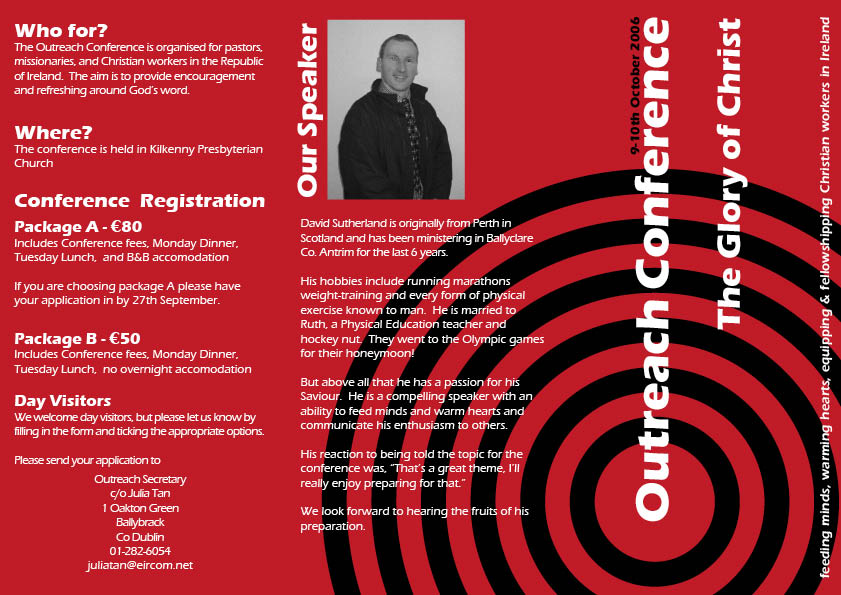
Outreach Conference 2006

Trial forms for the conference - posted for committee and others to look at.


Thursday, May 18, 2006

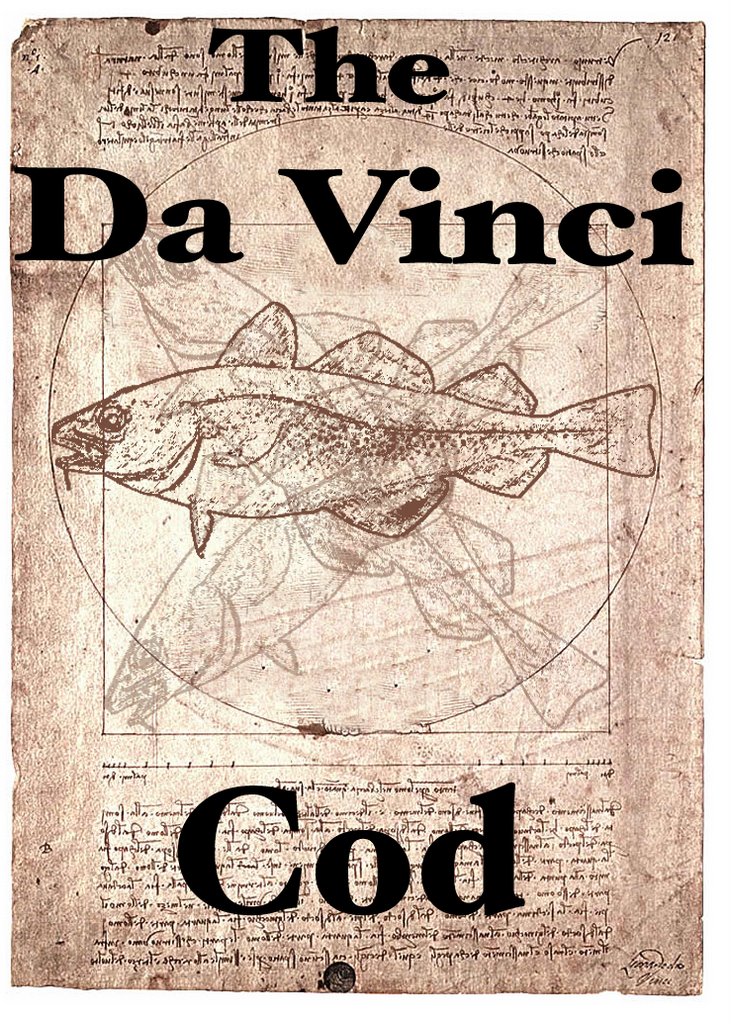
T-Shirt for Da Vinci tract distribution

As worn at Letterkenny Cinema by Simon and Mark

Thursday, May 11, 2006

Church Weed Watch

Gardeners' Corner
Weed Watch


Some of our gardens are in better shapes than others, but we always need to be on the lookout for weeds. The following are among the hardiest in the church garden, but need to be dealt with if any real growth is to be noticed.

Nonus Bendus - A particularly difficult weed to shift. Has been around for a long time and has never budged before, so why start now. Very attached to its roots.

Notmyjobis - While many other plants take their part in breaking up the ground, fertilising the soil, pollinating and flowering, etc., this weed takes no active role in the flowerbed. Best recognised by its total dormancy.

Mono Mano Bandis - A close relation to the previous culprit, this weed is often surrounded by a number of others of similar ilk. It leaves all the work of the garden up to the gardener; after all "that's what he's paid for".

Infearandtremblingus - Masquerades as a flower, but is actually a weed. This plant is paralysed by a sense of weakness. It is easily discouraged by the hardness of the soil and the hazardous climate. Sounds like a plant that needs special care, but, however, this weakness is only a 'red herring'; the plant is known for drooping in even the best of climates. It will hold back any growth or expansion in the flowerbed.

Me inmy smallcornerus - Experts have concluded that this is not one plant but a tightly knit cluster of plants which huddle together and can fill a flowerbed. Sounds good, but this group produces nothing good, and will reject any attempt to bring in new life. Happy with things the way they are, they have no desire to see new plants.

Dividusandconquerus - Looking much like a flower to begin with, this is actually a hostile weed. It moves into a flowerbed and very quickly entrenches itself between other plants, causing great damage. Other plants fail to flower because all their energy is sapped combating this weed. Consequently the plot becomes very dishevelled in appearance. Characterised by an utter lack of regard for other plants.

Sacrificeisntmykettleoffishus - Other plants will gladly give up some of their space, or do without for the good of the flowerbed. Many other plants recognise the principle of growth through sacrifice. Not this weed; it is unwilling to give up anything for others or for itself.

Neitherhotnorcoldus - Is it a flower or a weed? We're not quite sure. It certainly doesn't bloom like a flower, or show any interest in the beauty or growth of the flowerbed.

Nowyouseemenowyoudontus - Can use up valuable resources in a flowerbed if you have a number of these. Very difficult to deal with. Often deep rooted, but rarely seen, except when they need attention.

Thursday, April 20, 2006

Book Review - God, Satan and the Jews


God, Satan and the Jews
Frederick S. Leahy
Cameron Press

With a title like this one you might wonder what sort of a book this is. Perhaps it’s one of those wildly speculative books that links together the Jews with some bizarre end times prophecies. Not from the late Professor Leahy it isn’t. He was a man renowned for basing his thinking securely on what God had revealed, rather than on what we might speculate.

Instead this book is a safe introduction to, as the subtitle puts it, “The place of the Jews in Prophecy and History.” Perhaps you aren’t really sure what the Bible teaches about the Jews now that Jesus has come. Perhaps you’re wondering “What place is there for them in God’s plan?”.

If you’re not sure how to answer – then this is the place to start. In typical concise fashion Prof Leahy lays out the basic teaching of scripture on the place of the Jews. It is a brief book, but it will answer many questions. Not only does he model careful biblical thought, but also he displays a tenderness and love for the Jewish people that we should learn from.

Tuesday, April 18, 2006

Milford Reformed Presbyterian Church

Here's a map and directions for anyone looking to come to our church in Milford.

Coming from Lettereknny via Ramelton you will be coming in at the bottom right corner of the map.

The Church is the first one you come to as you head out the Kilmacrenan Road.

Service on Sunday morning is at 12 noon.

Map drawn by John Callanan

Monday, April 17, 2006

New Life Fellowship, Letterkenny


Here's directions to where we met in Letterkenny should anyone want to come along some Sunday morning. It would be great to see you.

If you're passing through on holidays or whatever you'd also be welcome to drop by.

  • Coming into Letterkenny from the Dry Arch roundabout go straight on at the next two roundabouts.
  • This will take you up to a set of traffic lights at Main street. Going straight over and down Main street, you pass the square on the right (small area with a bandstand).
  • Take the first road on the left after the square (just before the library).
  • Take the second road off it to the left and the Day Centre is the single storey building at the end.